
Nyx FlyBrain Chess Grandmaster: The 164,587-Neuron Chess AI Explained
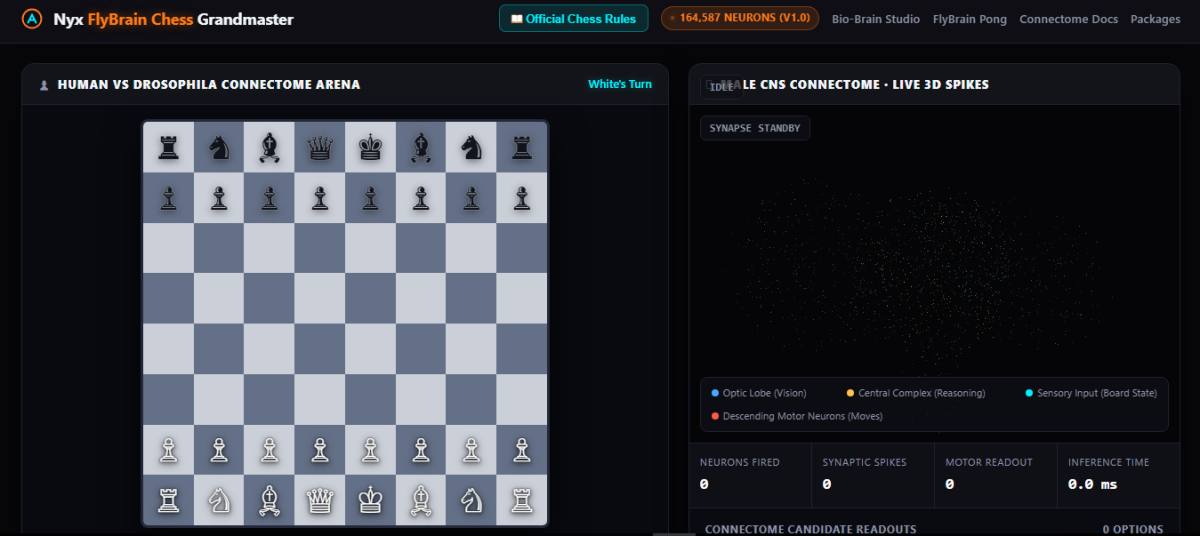
Nyx FlyBrain Chess Grandmaster is an experimental browser-based chess game that combines standard chess rules with a computational model inspired by the wiring of the Drosophila melanogaster nervous system. The game presents a Human vs Drosophila Connectome Arena, where players can challenge a fly-brain-based engine through different neural simulation depths. Its published architecture describes 164,587 simulated neurons, a sparse synaptic network, 882 motor-readout outputs, and Leaky Integrate-and-Fire (LIF) neural dynamics. That number is especially interesting because the underlying scientific MaleCNS project now contains 166,691 proofread neurons across the male fly's brain and nerve cord; 164,587 is a separate computational node count reported for a traced/compiled representation of that connectome.
What Is Nyx FlyBrain Chess Grandmaster?
Nyx FlyBrain Chess Grandmaster is a web-based chess experiment built around the idea of using a biological neural connectome as the foundation for a chess-playing system.
Instead of presenting itself as an ordinary chess engine based solely on traditional search algorithms, the game describes its opponent as a Drosophila connectome and displays simulated neural activity while the match is being played.
The interface combines two very different worlds: the familiar 8×8 chessboard and a visualization of biological-style neural processing. Players can see labels such as Optic Lobe, Central Complex, Sensory Input, and Descending Motor Neurons, alongside telemetry for neurons fired, synaptic spikes, motor readout and inference time.
The concept is closely related to modern connectomics, the scientific effort to map the neurons and synaptic connections that make up a nervous system. In 2026, researchers published a complete male Drosophila central nervous system connectome containing 166,691 neurons and 11,691 annotated neuron types. The dataset covers the brain and nerve cord and makes it possible to follow neural pathways from sensory inputs toward motor outputs.
The Science Behind the Fly-Brain Idea
A connectome is essentially a wiring diagram of a nervous system: which neurons exist, which neurons connect to which others, and how information may flow through those connections. The FlyWire project, for example, has reconstructed an adult female fly brain containing 139,255 neurons and more than 50 million synapses.
The newer MaleCNS project goes further by reconstructing the complete male central nervous system. Researchers report 166,691 neurons spanning the brain and ventral nerve cord, with roughly 25.6 million graph edges between neurons in the reconstructed connectome.
The exciting part for computing is that scientists and engineers can turn these biological wiring diagrams into computational networks.
That does not mean a computer has literally recreated a fly's mind.
A connectome is primarily a structural map. Turning that map into a functioning artificial neural system requires additional decisions about neuron dynamics, inputs, outputs, synaptic weights and how the system should interact with a task.
Nyx FlyBrain Chess appears to be an experimental implementation of this idea for chess.

Why the Game Says 164,587 Neurons
One of the most interesting technical details on the Nyx page is its 164,587-neuron figure.
At first glance, this may look like a contradiction with the newly published MaleCNS count of 166,691 neurons.
It is not necessarily a contradiction.
The scientific MaleCNS dataset contains 166,691 proofread neurons. A separate open-source computational project, ConnecTorch, reports compiling a traced MaleCNS representation into 164,587 nodes, with 25,563,197 aggregated connections representing about 124 million synapses.
That provides a plausible explanation for Nyx's 164,587 figure: the game is apparently working from a computationally selected or compiled representation rather than simply taking every neuron in the published anatomical dataset one-for-one.
The important distinction is:
| Figure | Meaning |
|---|---|
| 166,691 neurons | Published complete male Drosophila CNS connectome |
| 164,587 nodes | Computational representation reported by ConnecTorch |
| 164,587 neurons on Nyx | Number presented by the game for its neuromorphic engine |
The game should therefore be understood as a connectome-based computational experiment, not as a literal biological fly brain sitting inside a computer.

How the Chess Game Works
The chess side of Nyx follows conventional rules.
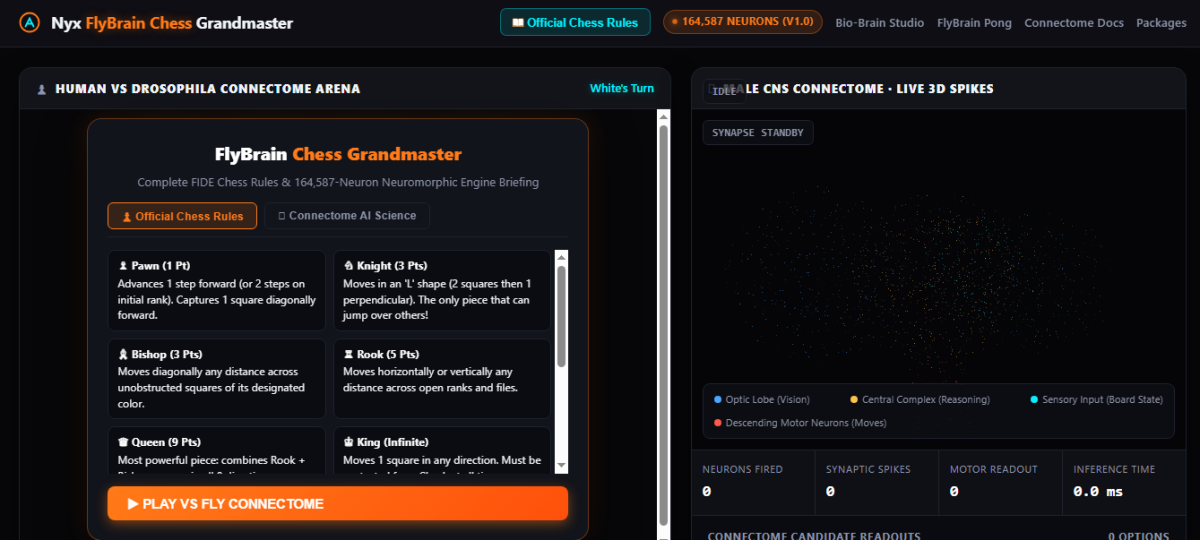
The interface explains movement for all six chess pieces and supports the major special rules:
-
Castling
-
En passant
-
Pawn promotion
-
Check
-
Checkmate
-
Stalemate
-
Draw conditions
The game's rule panel says White moves first, players alternate turns, and the objective is to checkmate the opposing king.
Those rules broadly correspond with the official FIDE Laws of Chess. FIDE defines checkmate as the position in which a player's king is under attack and there is no legal move to escape; its rules also cover castling, promotion, en passant and draw procedures.
So although the opponent's decision-making mechanism is unusual, the board itself is built around familiar chess.
The Three Neural Playing Modes
Nyx gives the player several ways to challenge the system.
Dynamic Spiking — Fast
This mode is designed for quicker responses.
The concept is to use the simulated neural system with less computational depth, making the game feel more immediate.
Full Connectome Depth — Standard
The Standard option increases the neural processing used to evaluate the position.
This is intended as the middle ground between speed and deeper neural computation.
Deep Synaptic Search — Grandmaster
This is the most ambitious setting.
The game labels it Grandmaster, suggesting that it performs deeper processing of candidate moves before selecting an action.
That name should be interpreted as the game's own mode description rather than proof that the system has demonstrated grandmaster-level chess strength in an independently verified rating test.
What Is LIF Neural Simulation?
The technical material displayed by Nyx uses Leaky Integrate-and-Fire, commonly abbreviated LIF.
LIF models represent neurons using a membrane-potential-like value.
The general idea is simple: incoming signals increase the neuron's activity, the activity gradually leaks away, and when the value crosses a threshold, the neuron produces a spike before being reset.
The Nyx code displays values including:
decay = 0.92
v_leak = -70.0
v_thresh = -50.0
The code then compares the updated voltage against the threshold and resets a neuron when a spike occurs.
This approach is commonly used in spiking-neural-network research because it captures an important feature of biological neurons—communication through discrete spikes—without requiring an extremely detailed biophysical model.
From Board Position to Neural Activity
The project's displayed ConnectomeCircuit contains three major components:
| Component | Role presented by the project |
|---|---|
| 164,587 neurons | Simulated neural states |
| Sparse synaptic matrix | Represents connections between neurons |
| 882 motor readouts | Candidate outputs used to decode an action |
The game also shows a function that takes a chess-board state, allocates a computational representation of it, propagates LIF spikes and then decodes the resulting activity into a move evaluation.
In simplified terms, the pipeline is:
Chess position → neural input → spike propagation → neural activity → motor readout → chess move
This is fundamentally different from simply displaying a chess engine's recommended move.
What the "Motor Readout" Means
The game's interface uses Descending Motor Neurons (Moves) as part of its visualization.
In a biological nervous system, descending neurons help carry information from higher brain areas toward motor circuits. The MaleCNS research is particularly valuable because it provides continuous anatomical coverage from the brain into the ventral nerve cord, making sensory-to-motor pathways easier to investigate.
Nyx adapts this biological idea to chess.
Instead of controlling legs or muscles, the final output has to control a chess move.
The game therefore needs a decoding layer that translates neural activity into legal chess actions.
That translation layer is one of the most interesting engineering aspects of the project.
Why the Drosophila Connectome Is Useful for AI Experiments
The fruit fly has a tiny nervous system compared with humans, but researchers have discovered surprisingly sophisticated neural circuits inside it.
The fly's central complex, for example, has been studied as a circuit involved in navigation, orientation and action selection. Researchers have identified recurrent networks capable of integrating sensory information and supporting flexible behavior.
That makes the fly an attractive model for computational neuroscience.
Scientists do not need to reproduce the enormous number of neurons found in a human brain to investigate useful principles of neural computation.
A compact organism with a completely mapped nervous system offers something extremely valuable: a neural architecture that researchers can inspect in detail.
Is Nyx Really a Fly Playing Chess?
No—not literally.
The title FlyBrain Chess Grandmaster is a description of the computational concept.
There is no evidence that an actual fruit fly has been trained to understand the rules of chess.
Instead, the project takes connectome-inspired computational structures and applies them to a chess environment.
That distinction is important because the underlying scientific research does not show that Drosophila naturally understands chess. The MaleCNS project is a scientific map of biological neural circuitry, while Nyx is an engineered application built around a computational interpretation of that type of neural architecture.
What Makes the Game Different From a Normal Chess Engine?
Traditional chess engines generally rely on carefully engineered evaluation functions, game-tree search, databases and various optimization techniques.
Nyx takes a more experimental route.
Its published interface emphasizes:
Biological connectivity
The model is associated with a real mapped nervous system rather than an entirely artificial, arbitrarily connected network.
Spiking computation
The architecture uses LIF-style neural dynamics rather than treating every unit as a conventional static mathematical node.
Neuromorphic visualization
Players can watch simulated spikes and neural activity while playing.
Motor decoding
The system attempts to transform distributed neural activity into a practical chess action.
That makes the game interesting even apart from whether it can beat strong traditional chess engines.
The Live Neural Telemetry
One of the game's most unusual features is the live telemetry panel.
It tracks:
| Display | Purpose |
|---|---|
| Neurons Fired | Number of neural units that have fired during processing |
| Synaptic Spikes | Spike activity passing through the simulated network |
| Motor Readout | Activity associated with possible actions |
| Inference Time | Time taken to process the position |
| Candidate Readouts | Number of candidate outputs identified |
The interface also presents the neural system in stages, including Optic Lobe (Vision), Central Complex (Reasoning), Sensory Input (Board State) and Descending Motor Neurons (Moves).
The terminology is inspired by biological organization, but the exact mapping between those labels and the biological fly circuits would need to be documented in the project's underlying implementation before treating the visualization as a scientifically faithful reproduction.
Does 164,587 Neurons Automatically Make It a Powerful Chess AI?
Not necessarily.
Neuron count alone does not determine playing strength.
A neural system can contain hundreds of thousands of units and still perform poorly at a task if its architecture, training, input encoding, output decoding or search strategy is not effective.
This is particularly important when comparing Nyx with established chess engines.
To establish that the system is genuinely playing at grandmaster strength, independent testing would be needed, such as large numbers of games against established engines, Elo estimation, controlled time controls and reproducible benchmarks.
The project's Grandmaster label is therefore best understood as the name of its deepest chess mode until independent rating evidence is available.
The Bigger Scientific Importance
The most interesting part of Nyx may ultimately have little to do with winning chess games.
The project sits at the intersection of three growing fields:
Connectomics: mapping biological neural wiring.
Neuromorphic computing: building computational systems inspired by how nervous systems process information.
Artificial intelligence: using those systems to solve practical tasks.
Recent Drosophila research makes this especially timely. The MaleCNS dataset provides researchers with an unusually complete structural map of a complex animal nervous system, including pathways connecting sensory systems with motor output.
Projects such as Nyx explore what happens when that kind of biological architecture is treated not only as something to study, but also as something from which computational systems can be built.
Final Verdict
Nyx FlyBrain Chess Grandmaster is an unusual and ambitious experiment.
It takes an ordinary game of chess and places it inside a very different computational framework: a simulated neural system inspired by the wiring of a fruit fly.
Its headline 164,587-neuron architecture connects directly to a broader 2026 development in neuroscience, where researchers published a complete male Drosophila central nervous system containing 166,691 neurons. The difference between the two numbers appears to reflect the distinction between the full scientific connectome and a computationally compiled representation.
What makes Nyx especially interesting is the attempt to connect the entire pipeline:
a chessboard position enters the system → neural activity spreads through a sparse network → candidate activity is decoded → the system produces a chess move.
Whether that approach can compete with the world's strongest chess engines is a separate question.
But as an experiment in connectome-based AI, it offers a fascinating demonstration of how discoveries in neuroscience can inspire completely different kinds of computing.
Reference Sources
Nyx FlyBrain Chess Grandmaster — official project page supplied for this article: Nyx FlyBrain Chess
Janelia Research Campus — Male CNS Connectome: the complete male Drosophila CNS project and its current 166,691-neuron dataset. (Male CNS Connectome)
Cell / Google Research — Sexual dimorphism in the complete connectome of the Drosophila male central nervous system: current published MaleCNS research and neuron counts. (Google Research)
FlyWire Codex: adult fly connectome datasets and explanation of connectomics. (Codex)
FIDE Laws of Chess: official rules covering checkmate, promotion, en passant, castling and draws. (FIDE Handbook)
ConnecTorch: computational representation of the MaleCNS dataset reporting 164,587 compiled nodes. (GitHub)
Comments
No comments yet. Be the first to share your thoughts!