

The Ethical Implications of AI-Generated Content in Journalism
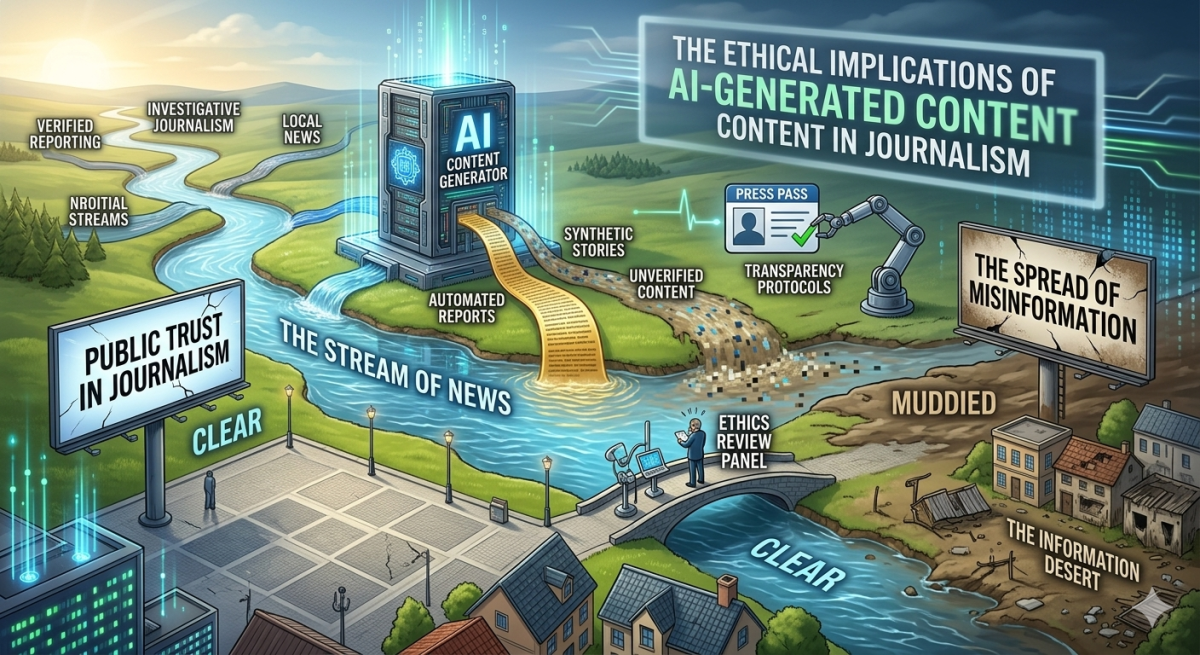
Artificial intelligence is changing journalism quickly. Newsrooms can now use AI to summarize documents, transcribe interviews, translate material, suggest headlines, assist with research and automate some routine publishing tasks. At the same time, generative AI can produce convincing false information, fabricated quotations, manipulated images and text that looks authoritative even when it is wrong.
That creates a difficult question for journalism: How can news organizations use AI without weakening the accuracy, independence and public trust that make journalism valuable?
The issue is no longer whether AI will enter journalism. It already has. The more important question is where the ethical boundaries should be.
The Reuters Institute reported in 2026 that news organizations continue to expand their use of AI, particularly for back-end automation, newsgathering, coding and product development. At the same time, audiences remain much more comfortable with human-led journalism than fully AI-produced news. In its 2025 research, only 12% of respondents across six countries said they were comfortable with news produced entirely by AI, compared with 62% for entirely human-made news.
This gap is important. It shows that efficiency alone is not enough. Journalism is a public trust activity, so the use of AI must be judged not only by what the technology can do, but also by what it means for truth, accountability, fairness, privacy, copyright, employment and the relationship between journalists and their audiences.
Summary
-
Topic: Ethical implications of AI-generated content in journalism
-
Main issue: How journalism can use AI while protecting accuracy, accountability and public trust
-
Major benefits: Faster research, transcription, translation, editing, summarization and some forms of automation
-
Major risks: Hallucinations, misinformation, bias, fabricated sources, manipulated media and reduced transparency
-
Central ethical principle: Human journalists and editors must remain responsible for published work
-
Transparency principle: Audiences should know when AI materially contributes to published content
-
Copyright concern: AI systems may be trained on or reproduce protected material, creating disputes about ownership, licensing and attribution
-
Employment concern: Automation can change newsroom jobs and shift which skills are valued
-
Public-trust concern: Readers may become less confident in news when they cannot tell how it was produced
-
Current direction: Major journalism organizations are developing newsroom AI policies and ethical standards
-
2026 development: AP updated its newsroom AI standards, while SPJ proposed revisions to its ethics code addressing artificial intelligence, verification, misinformation and transparency.
What AI-Generated Content Means in Journalism
AI-generated content is material created wholly or partly with an artificial intelligence system. In journalism, this can range from a simple AI-assisted headline to an entire article drafted by a language model.
These uses are not ethically identical.
Using AI to correct grammar in a journalist's own article is very different from publishing an election story written primarily by a chatbot without independent reporting. Likewise, using software to transcribe an interview is different from asking an AI system to invent a quote that sounds like something a source might have said.
This distinction matters because the ethical question is not simply "Was AI used?" It is "What did AI do, how much did it influence the published material, and what human responsibility remained?"
The Associated Press provides a useful example. Its updated July 2026 standards allow AI to assist with early research, document summarization, transcription, translation, headlines, story summaries, grammar and search optimization. However, AP says AI output must be reviewed and edited by journalists, and that AI does not replace reporting, sourcing, editorial judgment or verification.
Reuters takes a similar approach. Its standards state that journalists must independently verify facts and claims generated by AI because language models can produce persuasive but inaccurate information. Reuters also states that editorial accountability remains with the organization and its journalists.
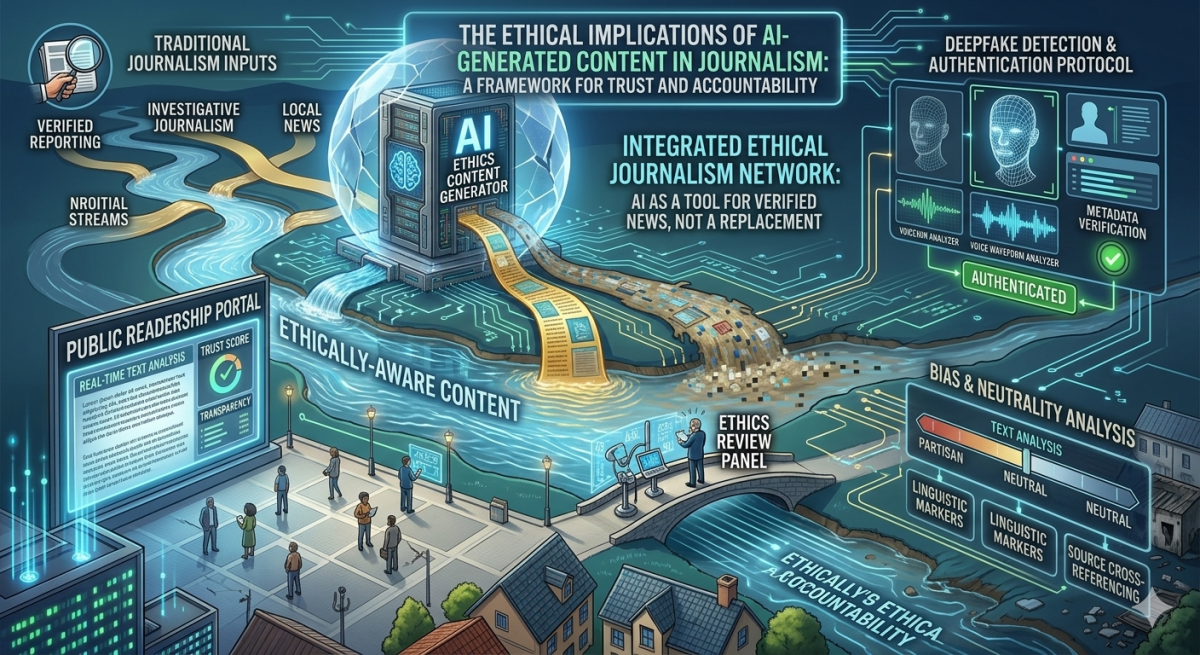
This suggests a useful ethical framework: AI can assist journalism, but it should not become a substitute for journalistic responsibility.
The Biggest Ethical Issue: Accuracy
Accuracy is the foundation of journalism.
A journalist is expected to check facts before publication, identify reliable sources, provide context and correct errors. AI systems make this responsibility harder because they can produce information that sounds confident while being unsupported or incorrect.
This is especially dangerous because an AI-generated mistake does not always look like a mistake.
A fabricated name, incorrect date or invented quotation may appear perfectly reasonable. An inexperienced journalist can therefore mistake fluency for truth.
Reuters explicitly warns its journalists never to trust unverified or unattributed facts produced by an AI system and requires AI-generated claims to be independently checked.
The Reuters Institute's 2026 research also highlights the public's concern. Only 33% of respondents in its six-country study believed journalists always or often check AI outputs before publishing them. Among people who strongly trusted news, 57% thought journalists routinely performed such checks, compared with only 19% among strong distrustors.
This means verification is not merely a technical process. It is a trust issue.
A newsroom may believe its journalists are checking everything, but if the audience does not understand the process, confidence can still fall.
AI Hallucinations and Fabricated Information
One of the most serious problems with generative AI is what is commonly called a hallucination: an output that presents false or unsupported information as though it were true.
In journalism, hallucinations can take many forms:
-
Invented quotations
-
Fake citations
-
Incorrect dates
-
Misidentified people
-
Fictional events
-
False statistics
-
Distorted summaries
-
Incorrect descriptions of court cases
-
Fake historical details
The ethical problem becomes greater when journalists publish these errors without checking them.
A recent 2026 case outside journalism illustrates the seriousness of the issue. A Mississippi federal judge acknowledged that an AI-assisted court order contained errors and fictitious legal citations, prompting an appeal and concerns about the reliability of AI-assisted decision-making. While courts and newsrooms are different institutions, the case demonstrates why fluent AI output cannot be treated as inherently reliable.
For journalism, the lesson is straightforward: AI-generated information is a lead to investigate, not automatically a fact to publish.
The Problem of Transparency
Another major ethical question is whether journalists should tell readers when AI was used.
There is no universally accepted rule that every minor AI-assisted action needs a disclosure. For example, telling readers that spell-check software helped correct a typo would probably add little value.
But the ethical situation changes when AI materially contributes to the content itself.
Consider two articles.
In the first, a journalist writes the entire story after interviewing sources and checking documents. AI is used only to correct spelling.
In the second, an AI system writes most of the article, while an editor performs limited review before publication.
Treating these two situations as identical would not give audiences enough information about how the journalism was produced.
Reuters says transparency is part of its approach to generative AI, while AP's updated standards include disclosure rules for cases where generative AI plays a material role in published content.
The Society of Professional Journalists is also moving in this direction. In August 2026, its Ethics Committee proposed revisions to its Code of Ethics that retain its four core principles while adding stronger guidance on artificial intelligence, verification, misinformation, source transparency and accountability. The proposal is still subject to approval, so it should not be treated as a finalized replacement code.
Why Transparency Matters to Readers
The Reuters Institute's latest research shows why this discussion is important.
Across six countries, only 12% of respondents were comfortable with news generated entirely by AI. Comfort increased to 21% when a human remained in the loop and to 43% when a human journalist led the process with some AI assistance. Entirely human-made news reached 62%.
People were also much more comfortable with behind-the-scenes uses such as grammar editing and translation than with artificial presenters, AI-created images or automated authors.
This suggests that audiences do not necessarily reject AI. Instead, they distinguish between AI as a tool for journalists and AI replacing journalists.
That distinction could become central to newsroom policy.
Bias and Representation
AI systems learn from large quantities of existing data. Because that data reflects human societies, it can also reflect human biases.
A system may reproduce stereotypes involving race, gender, nationality, religion, social class or political viewpoints. It can also reproduce imbalances in whose voices are represented in its training material.
This creates a particular problem for journalism because journalists are expected to provide fair and diverse coverage.
Reuters warns that AI systems can reflect human biases and says AI-generated work must be subjected to the same impartiality checks applied to other journalism.
UNESCO has similarly emphasized that AI systems can produce unequal benefits, exclusions and risks to human rights. Its journalism guidance argues that journalists need enough understanding of AI to report on its social and political implications rather than simply repeating industry claims.
The ethical responsibility therefore extends beyond checking whether a sentence is factually correct. Journalists must also ask whether AI has introduced a distorted frame or excluded important perspectives.
AI-Generated Images and Manipulated Media
Visual journalism creates another difficult ethical problem.
A realistic AI-generated image can appear to show an event that never happened. A manipulated photograph can make a real event appear different from reality.
This can damage journalism because audiences often treat photographs and videos as direct evidence.
Reuters has strict rules around visual authenticity. Its standards prohibit generative AI from creating or enhancing imagery used as Reuters visual journalism, while allowing approved AI technologies for tasks that do not alter the underlying visual evidence.
Reuters also maintains a dedicated visual-verification operation designed to authenticate user-generated photos and videos. The organization says verification can involve checking the source, metadata, weather information, satellite imagery and other eyewitness material, while also using AI-detection technology with the understanding that detection tools are not perfect.
This illustrates an important principle: the solution to synthetic media cannot simply be another AI tool. Human verification and multiple forms of evidence remain necessary.
Deepfakes and Public Deception
Deepfakes create an even more serious version of the problem because they can make people appear to say or do things they never said or did.
This is particularly dangerous in elections, conflicts, criminal investigations and breaking-news situations.
UNESCO has warned about AI-generated false images and other synthetic content undermining information integrity at scale. It describes the growing ability to create realistic synthetic material as a challenge to public understanding and media freedom.
The European Union has responded with transparency rules. Article 50 of the EU AI Act applies from August 2, 2026, and includes requirements concerning the marking and disclosure of certain AI-generated or AI-manipulated content. In particular, AI-generated text published on matters of public interest is subject to disclosure requirements unless it has undergone human review or editorial control with a person or organization holding editorial responsibility. Deepfakes must also be disclosed as artificially generated or manipulated in the circumstances covered by the law.
The European Commission published additional guidance and a Code of Practice in 2026 to help organizations comply with these transparency requirements.
This is an important development because transparency is moving from being purely an ethical recommendation toward becoming a regulatory requirement in some jurisdictions.
Copyright and the Rights of Creators
Copyright is another major ethical issue.
Generative AI systems are built using large collections of information, including material created by humans. This raises questions about whether creators were properly compensated or whether their work was used without permission.
For journalism, the concern has two sides.
First, news organizations may worry that AI systems use their reporting as training material without appropriate licensing or payment.
Second, journalists themselves may unknowingly generate text that closely resembles protected material or use AI systems without understanding the rights attached to the output.
The U.S. Copyright Office has been studying these issues since 2023. In January 2025, it concluded in Part 2 of its AI report that generative AI output can receive copyright protection where a human author determines sufficient expressive elements, but that merely providing prompts is not enough by itself. It also stated that AI assistance does not automatically prevent a larger human-created work from being copyrightable.
The legal questions are still developing, but the ethical principle is easier to understand: journalists should know where information and creative material come from and respect the rights of the people who created it.
Plagiarism and Attribution
Journalism depends heavily on attribution.
A journalist should identify where important information came from, especially when using another person's reporting, data, photographs or original investigation.
AI can make plagiarism more difficult to detect because generated text may combine information from numerous sources without clearly showing the origin of each claim.
The Society of Professional Journalists' existing code tells journalists to use original sources whenever possible, identify sources clearly and never plagiarize. It also requires journalists to provide context and take responsibility for accuracy.
Those principles remain relevant even when AI is involved.
AI does not remove the ethical obligation to credit original reporting.
Privacy and Sensitive Information
Journalists often handle sensitive material: unpublished documents, contact information, interview transcripts, photographs, legal records and information about vulnerable people.
Uploading such material into an external AI system can create privacy and confidentiality concerns.
A reporter might paste an unpublished interview transcript into a chatbot to obtain a summary. Another might upload a confidential document because an AI tool makes it easier to search.
The ethical question is what happens to that information after it leaves the newsroom.
This becomes particularly important when sources have provided information on the understanding that the journalist will protect their identity or confidentiality.
A responsible newsroom therefore needs to know:
-
What information may be uploaded into AI systems
-
Which tools have been approved
-
What data those systems retain
-
Whether confidential information is used for model improvement
-
Who has access to the material
-
Whether sensitive information is anonymized before processing
The principle behind these questions is the same one that has always applied to journalism: protect people who may suffer harm because information was handled carelessly.
The Human Cost: Employment in Journalism
AI also has implications for journalists' jobs.
Newsrooms face financial pressure, declining advertising revenues and changing audience habits. AI can reduce the time required for certain repetitive tasks, which may make some organizations more efficient.
But efficiency can also become a reason to reduce human staff.
The ethical question is therefore not simply whether AI can replace a task. It is whether replacing that task removes something valuable from journalism.
A newsroom may save money by reducing reporters and using automated systems for large amounts of content. But fewer reporters can mean fewer original investigations, fewer local sources, less accountability reporting and less time spent understanding complex communities.
The Reuters Institute reports that publishers increasingly view AI as important to newsroom operations. In its 2026 trends research, 97% of publisher respondents considered back-end AI automation important, while 82% rated newsgathering applications important. Yet only 44% described their newsroom AI initiatives as showing promising results, while 42% described the results as limited.
This shows that AI adoption is not automatically equivalent to better journalism.
The Risk of Cheap, Low-Quality Content
Generative AI can produce large volumes of text at low cost.
That may be useful for simple, repetitive information, but it also creates an incentive to publish huge numbers of weak stories designed primarily to attract search traffic.
This can create an internet filled with pages that look informative but offer little original reporting.
The ethical problem is larger than individual mistakes. It concerns the overall information environment.
UNESCO has warned that information abundance does not guarantee quality or accuracy and that AI-generated content and deepfakes make it harder for people to distinguish facts from manipulation.
Journalism should therefore avoid measuring AI success only by output volume.
The number of articles produced is not the same as the amount of journalism produced.
One well-reported investigative story may be more valuable than 100 automatically generated summaries.
The Changing Relationship Between Journalists and Audiences
AI is also changing where people get their news.
The Reuters Institute reported in 2026 that weekly use of generative AI across the six countries studied had increased from 18% in 2024 to 34% in 2025. Weekly use specifically for getting news doubled from 3% to 6%.
This means some audiences are beginning to ask AI systems for explanations, summaries and current events instead of visiting news websites directly.
That creates an ethical and economic problem.
Journalism requires resources. Reporters have to investigate, travel, interview sources, analyze documents and verify claims. If AI systems summarize that reporting without sending enough audiences back to original publishers, the economics of journalism may weaken.
The Reuters Institute's 2026 Digital News Report identifies this as a major challenge, particularly because AI-generated search answers can reduce the need for users to click through to the original sources.
The ethical issue here is not simply about business revenue. A healthy journalism system needs enough money and independence to continue producing original reporting.
Who Is Responsible When AI Gets It Wrong?
Accountability is one of the hardest questions.
Suppose a journalist uses an AI tool, an editor reviews the article and the article contains a serious false claim. Who is responsible?
The AI system cannot meaningfully apologize to the source or correct the public record.
The ethical answer must therefore remain human.
AP explicitly places editorial judgment, verification and accountability on its journalists. Reuters similarly states that the organization remains responsible for the journalism it publishes regardless of whether AI was involved.
This principle should apply throughout the newsroom:
The person who publishes the story is responsible for ensuring that the story is true, fair and properly sourced.
AI can explain, summarize, translate or assist. It cannot carry the moral responsibility of journalism.
Current Ethical Approaches by Major Journalism Organizations
| Organization | Current approach to AI | Main ethical principle |
|---|---|---|
| Associated Press | Allows AI for defined support tasks including research, summarization, transcription, translation and editing | Human review, verification and accountability |
| Reuters | Uses approved AI tools but requires independent verification and editorial accountability | Accuracy, transparency and human responsibility |
| UNESCO | Promotes responsible, human-centered AI use and media literacy | Public interest, human rights and information integrity |
| Society of Professional Journalists | Retains its four core ethical principles while proposing new AI and verification guidance in 2026 | Truth, minimizing harm, independence and transparency |
| European Union | AI Act transparency rules apply from August 2, 2026, including disclosure requirements for certain AI-generated public-interest content and deepfakes | Transparency and protection against deception |
Ethical Guidelines for Newsrooms Using AI
A newsroom does not need to reject AI to use it responsibly.
A better approach is to establish clear internal rules.
1. Keep humans responsible for every published story
Every article should have a journalist or editor who is accountable for its factual accuracy.
2. Verify every important factual claim
Names, dates, quotations, statistics, legal claims and statements about public figures should be independently checked.
3. Do not use AI as a substitute for reporting
AI can help organize information, but original journalism should still come from reporters speaking to sources, examining evidence and observing events.
4. Establish clear disclosure rules
Readers should be told when AI has played a material role in published content.
5. Protect confidential information
Sensitive information should not be placed into an AI system unless the newsroom understands the system's privacy and data-handling practices.
6. Check for bias
Journalists should examine whether AI has introduced stereotypes, omitted important perspectives or presented controversial issues without sufficient context.
7. Protect copyright
Newsrooms should track where content comes from and ensure that AI-assisted work does not simply reproduce someone else's journalism or creative material without proper attribution.
8. Treat AI-generated images with extreme caution
Never allow a synthetic image to be presented as documentary evidence of a real event.
9. Maintain correction procedures
AI-assisted stories should be corrected just as prominently as traditionally produced stories.
10. Train journalists continuously
Technology changes quickly, so an AI policy written once and never updated will eventually become outdated.
What Ethical AI Journalism Should Look Like
The strongest model is not human versus AI.
It is human journalism supported by carefully controlled AI tools.
AI is well suited to some tasks:
-
Transcription
-
Translation
-
Sorting large documents
-
Finding patterns in structured data
-
Grammar assistance
-
Administrative automation
-
Generating possible headlines
-
Summarizing material for a journalist's initial review
Human journalists remain essential for other tasks:
-
Deciding what is newsworthy
-
Interviewing sources
-
Assessing credibility
-
Understanding context
-
Investigating wrongdoing
-
Making ethical judgments
-
Protecting sources
-
Challenging powerful people
-
Deciding what information should be published
-
Taking responsibility for errors
That division of labor is consistent with the current policies of major journalism organizations. AP and Reuters both allow defined uses of AI while keeping reporting, verification and editorial accountability with people.
The Future of Journalism and AI
The ethical debate will become more important, not less.
AI systems are becoming more capable of creating text, images, audio and video that are difficult to distinguish from human-produced material. At the same time, AI chatbots are increasingly becoming a place where people ask questions and consume information.
The Reuters Institute describes AI as one of the biggest challenges facing news leaders and policymakers, especially because publishers must decide how to work with AI platforms without undermining the economic foundation of original journalism.
The most important issue may therefore be trust.
People need to know that when they open a news story, there is a serious editorial process behind it.
They need to know that quotations were actually spoken, photographs actually show what the caption says, statistics were checked, sources were contacted, and important claims were not simply produced by a machine because they sounded plausible.
AI can make journalism faster.
It can make certain newsroom processes cheaper.
It can even help journalists discover information that would otherwise take much longer to organize.
But none of those advantages automatically make journalism better.
Journalism becomes better when technology helps journalists discover and explain the truth without weakening their responsibility to the public.
Frequently Asked Questions
What is AI-generated content in journalism?
AI-generated content is text, images, audio, video or other material created wholly or partly using artificial intelligence. In journalism, this may include everything from AI-assisted headlines and summaries to automatically produced articles.
Is it ethical for journalists to use AI?
Yes, AI can be used ethically when its role is appropriate, its output is verified and human journalists remain responsible for the final work. Major organizations including AP and Reuters allow defined forms of AI assistance under editorial controls.
What is the biggest ethical problem with AI in journalism?
Accuracy is one of the biggest concerns because AI can generate false information, fabricated citations and invented quotations that may sound convincing.
Should journalists disclose AI use?
When AI plays a material role in published content, disclosure can help audiences understand how the journalism was produced. AP includes disclosure standards for material generative-AI use, while transparency is also emphasized by Reuters and European regulatory frameworks.
Can AI replace journalists?
AI can automate some journalism-related tasks, but responsible journalism still requires human reporting, source evaluation, ethical judgment, verification and accountability. Current AP standards explicitly state that AI does not replace reporting, sourcing or editorial judgment.
Can AI-generated journalism be biased?
Yes. AI systems can reproduce or amplify biases found in their training data. Reuters says AI-created material must be subjected to normal checks for impartiality, while UNESCO has highlighted concerns about exclusion and unequal effects associated with AI systems.
What is the danger of AI-generated images in journalism?
A synthetic image can falsely appear to document a real event. This can mislead audiences and damage public trust. Reuters therefore prohibits generative AI from creating or enhancing its news photography.
How does AI affect journalism jobs?
AI can automate repetitive tasks and change the skills required in newsrooms. It may improve efficiency, but excessive automation could reduce demand for some newsroom roles and potentially weaken original reporting if cost-cutting replaces journalists.
What does the EU AI Act say about AI-generated content?
The EU's Article 50 transparency rules apply from August 2, 2026. They include requirements for marking or disclosure in specified cases involving AI-generated or manipulated content, including certain public-interest text and deepfakes.
What is the proper role of AI in journalism?
A responsible role for AI is to assist journalists with tasks such as transcription, translation, document analysis, research support and editing while leaving reporting decisions, verification and accountability to human journalists.
References
Reuters Institute for the Study of Journalism — Generative AI and News Report 2025
Read the Reuters Institute research
Reuters Institute — Digital News Report 2026
Read the Digital News Report 2026
Reuters Institute — Journalism, Media and Technology Trends and Predictions 2026
Read the 2026 trends report
Reuters — Journalistic Standards
Read Reuters' standards
Associated Press — Updated Newsroom Standards for Artificial Intelligence, July 23, 2026
Read AP's updated standards
Society of Professional Journalists — Proposed 2026 Code of Ethics Revisions
Read the proposed revisions
Society of Professional Journalists — Code of Ethics
Read the SPJ Code
UNESCO — Reporting on Artificial Intelligence: A Handbook for Journalism Educators
Read the UNESCO handbook
UNESCO — World Press Freedom Day 2025 and AI's impact on journalism
Read the UNESCO article
U.S. Copyright Office — Copyright and Artificial Intelligence
Read the U.S. Copyright Office AI resources
U.S. Copyright Office — Part 2 of the AI Report
Read the 2025 report update
European Commission — AI Act Transparency Obligations
Read the EU transparency guidelines
SEO Keywords
ethical implications of AI-generated content in journalism, AI-generated content in journalism, AI and journalism ethics, artificial intelligence in journalism, journalism and artificial intelligence, ethical AI in journalism, AI journalism ethics, generative AI and journalism, AI-generated news, AI-generated journalism, AI newsroom ethics, journalism accuracy and AI, AI misinformation in journalism, AI hallucinations journalism, AI bias in journalism, AI transparency journalism, AI disclosure journalism, AI fact checking, human oversight in journalism, AI and public trust, AI and news credibility, AI-generated images journalism, deepfakes and journalism, AI copyright journalism, AI plagiarism journalism, AI privacy journalism, AI and journalist jobs, AI newsroom standards, responsible AI journalism, AP AI standards journalism, Reuters AI journalism standards, UNESCO AI journalism, SPJ journalism ethics AI, EU AI Act journalism, AI-generated public-interest content, future of journalism and AI
5 SEO Powerful Eye-Catching Title Options
-
The Ethical Implications of AI-Generated Content in Journalism: Truth, Trust and Accountability
-
AI and Journalism Ethics: How Artificial Intelligence Is Changing the Rules of News
-
AI-Generated News: The Biggest Ethical Risks Facing Journalism Today
-
Can AI Replace Journalists? The Truth About Ethics, Accuracy, Bias and Trust
-
The Future of Journalism in the AI Era: Ethics, Misinformation, Copyright and Public Trust
Hashtags
#AIJournalism #JournalismEthics #ArtificialIntelligence #GenerativeAI #AIandNews #NewsMedia #MediaEthics #Journalism #AIGeneratedContent #Misinformation #FactChecking #DigitalJournalism #MediaLiteracy #SceneGallery #ntertainment
Comments
No comments yet. Be the first to share your thoughts!